The 12 capabilities
They all run on one foundation: agents, a shared board, memory, Slack and per-person logins. The first capability is live and proves the foundation works. The rest are loops we build on top of it.
Build software autonomously
Idea → plan → code → test → a PR with proof → deploy. Working today up to the pull request. Merge and deploy are still done by hand.
WorkingRun product development
Feedback and bugs become specs and approved work.
Partly thereCoordinate across the company
Asana, blockers, and a Slack DM when a person's input is needed.
NextPersonal command center
What's mine, what's waiting on me, and what can ship.
Partly thereGrowth and social factories
Research, posts, replies and content calendars.
NextMarketing and business reporting
CAC/LTV, anomalies, executive summaries.
NextResearch and news intelligence
Save, research, summarize, brief the team.
Partly thereSupport and feedback loops
Triage, answer, and turn real problems into engineering tasks.
NextContinuous QA
Agents already test their own work in a real browser.
Partly thereReleases and documentation
Every PR already ships with its own docs and walkthrough.
Partly thereWork across all our products
PostMoney and VC Match share one factory. RailsGenerator is next.
Partly thereRapidly build internal tools
Small purpose-built apps, wired back to Innoventer.
NextWhat we set up, in about a week
One shared system instead of everyone running their own AI tools on their own laptop.
Our own infrastructure
Behind company Google sign-in. Everyone at Innovent logs in as themselves.
An agent per product
PostMoney and VC Match each have one, plus an orchestrator and a dedicated reviewer.
A shared board
Anyone can give an agent a task, watch it work, and pick up or redirect someone else's.
Slack
Message agents directly. #vc-match-eng goes straight to the VC Match agent.
Safe, realistic data
Every task gets its own copy of the app with scrubbed sample data. Agents never touch production or real customer information.
Memory
Agents keep notes and lessons from every task, so the next one goes better.
The software factory loop
What happens after someone writes a task.
- Anyone writes a taskOn the shared board or in Slack.
- The agent gets its own workspaceAn isolated copy of the app with sample data, so tasks never collide.
- It plans, builds and runs the full test suiteThousands of tests, every time.
- It uses the app like a customerIn a real browser, on desktop and mobile, and fixes what it finds.
- It hands over proofA live preview link, screenshots of every flow, and a plain-English explanation in the pull request.
- A person reviews and decidesThen merge and deploy.
How this is different from before
We were each developing alone with our own agents. Now it's one integrated factory.
The result: review becomes the job. People spend their time judging finished, proven work instead of producing it.
"Chat with your matches" for VC Match
A single task to the VC Match agent produced a complete, production-quality feature. Founders can have private AI conversations about their investor matches: prioritize outreach, compare investors and prepare for meetings, using only the reports they've paid for.
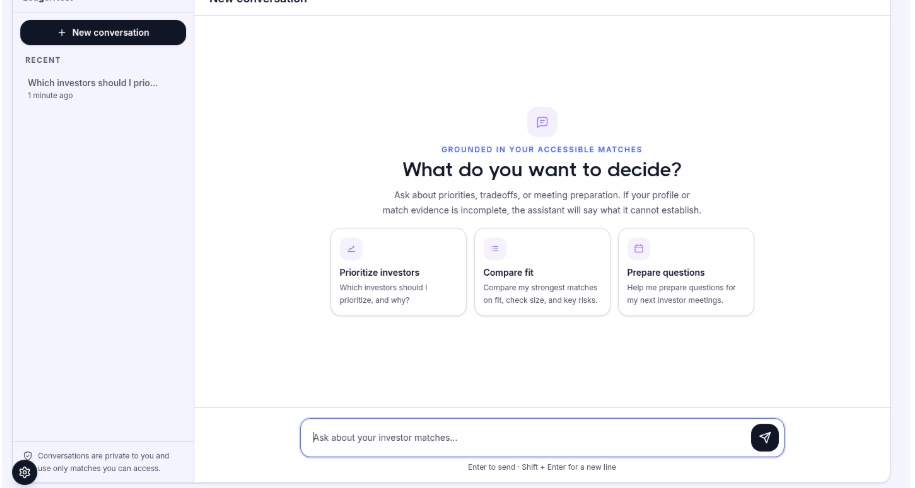
- The feature: conversation history, starter questions, cited sources, mobile layout and error recovery.
- Careful design: founders only see their own conversations and only the reports they're entitled to. If access changes, it fails safely.
- Self-QA: it used the app like a founder on desktop and mobile, and fixed the bugs it found before opening the PR.
- Proof for the reviewer: a live preview, an architecture diagram, and a screenshot walkthrough of every founder flow, all with real AI answers.
The pull request as the reviewer sees it
Open full size ↗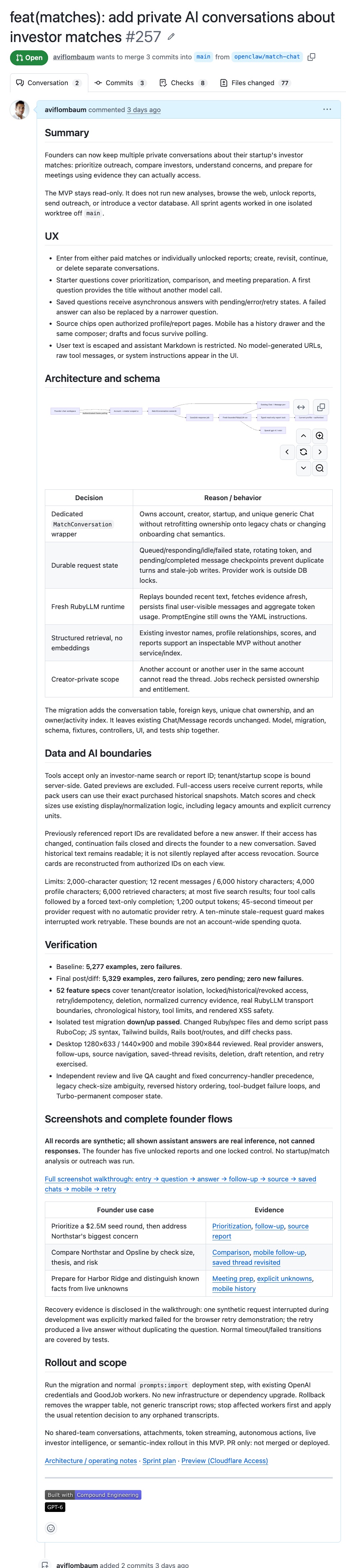
The screenshot walkthrough the agent produced
Open full size ↗
Where we're going
Build the loops one at a time, each on the same foundation.
Close the engineering loop
- Review comments go straight back to the agent to address.
- One-click approve → merge → deploy to staging → the agent verifies the deploy.
- Add RailsGenerator as the third product.
Connect the company
- Link agent work to Asana tasks and sprints.
- When an agent needs a decision, it DMs the right person in Slack and picks up again once they reply.
- A personal dashboard and a daily Slack digest: what's mine, what's waiting on me, what can ship.
Factories beyond engineering
- QA: agents regularly use our products like customers and file bugs with steps to reproduce.
- Support: triage the inbox, answer routine questions, turn real problems into engineering tasks.
- Reporting: daily and weekly summaries of acquisition, CAC/LTV and anomalies, written as explanations rather than dashboards.
- Research: save anything interesting and get it researched, summarized and linked to our work.
- Growth: research topics, draft posts and replies, with approval before anything goes out.
- Releases: release notes, changelogs and announcements generated from what shipped.
Guardrail: before agents handle customer data or take actions outside the company (sending email, posting), we tighten permissions and sandboxing. Today agents only produce pull requests, and a person always reviews them.